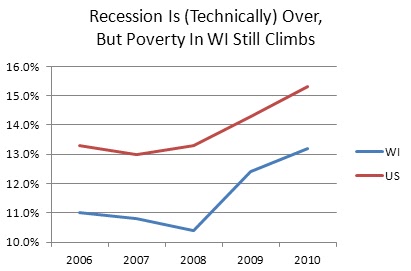
The number of Wisconsinites living in poverty jumped significantly between 2008 and 2010, new figures from the Census Bureau show. Between those years, the poverty rate in Wisconsin increased from 10 percent to 13 percent, and an additional 163,000 Wisconsinites slid into poverty. To put that number in perspective, the number of additional people living in poverty represents a population greater than the entire city of Green Bay. For a family of four, the 2010 poverty line was $22,050.
Wisconsin’s overall poverty rate (13 percent) is still lower than the U.S. average (15 percent), as shown in the chart below. But both the state and national poverty rates have climbed precipitously since 2008. This trend is especially troubling considering that the recession officially ended in June of 2009. Given that the economy made modest gains in 2010, one would hope that the number of people living in poverty in 2010 would level off at a rate similar to 2009. Unfortunately that didn’t happen.
There was a great deal of regional variation in poverty rates among Wisconsin counties. Milwaukee County, where more than one in five residents were poor, had the highest poverty rate among the 23 Wisconsin counties for which there were figures. (The sample size used by the Census Bureau does not permit it to report on poverty figures for counties with relatively small populations.) Surprisingly, in 2010 Eau Claire County had the second highest poverty rate, at 18 percent. Other counties with high rates of poverty were Racine (15 percent), Rock (14 percent) and Kenosha (13 percent).
Last week, we posted an analysis of the increase in child poverty in Wisconsin, which is even more dramatic than the increase in the overall poverty rate. Between 2008 and 2010, Wisconsin’s child poverty rate rose from 13.3 percent to 19.1 percent, and the number of children living in poverty increased by 43 percent. Household income in Wisconsin also plummeted during the recession, decreasing faster than the national average.
Given these trends, it’s especially important that the state adopt policies aimed at mitigating the effects of the recession. Instead, just the opposite has happened, as the state has raised taxes on working-class families and slashed investment in the public education system, while cutting taxes for the wealthy.
For additional analysis of income and poverty figures, see the WCCF press release.
Tamarine Cornelius