Read this editorial in the Milwaukee Journal Sentinel here.
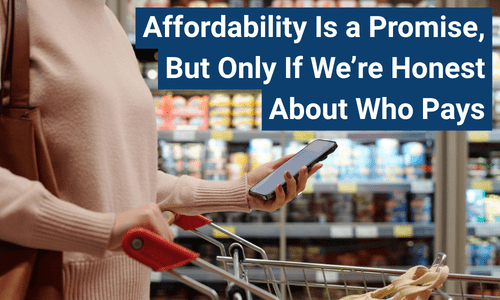
Affordability Is a Promise But Only If We’re Honest About Who Pays
“Affordability” has become the political word of the moment. From gas prices to groceries to child care, candidates across the spectrum are racing to show they understand what families are up against.
They are not wrong. Wisconsin families are struggling and stretched thin. Advocates recently have been sounding the alarms – when affordability is reduced to a mere talking point without a real plan, it becomes a broken promise and broken promises can erode our faith in democracy itself.
That warning should land heavily right now, especially for candidates running for Governor. Wisconsin voters are not just looking for empathy; they are looking for solutions and results they can feel in their monthly budgets. Real solutions for working families require something else the candidates are not saying loud enough. Affordability starts with revenue and with who we ask to contribute.
A moment to lead?
As candidates begin to define their economic agendas, they have a choice. They can continue to treat affordability as a slogan and promise relief without being real about the trade-offs, or they can level with voters that real affordability requires real revenue. Fairness in taxation is a major part of the solution to showing that the government can actually help working families by making everyday life cost less.
If we get that right, affordability won’t be a trap…It will be proof that our democracy is still capable of delivering on its promises.
The simple math we can’t ignore
For years, Wisconsin leaders have tried to make life more affordable for everyday families by trimming around the edges offering small tax cuts here, temporary relief there without addressing the underlying issue.
The reality is that in Wisconsin, a parent working full-time can still be raising a family in poverty. This is the affordability crisis in one sentence. This is not about whether people are working hard enough. It is about whether our policies allow work to actually pay.
If we are serious about affordability, the conclusion is unavoidable: to put money directly in families’ hands at scale is one of the most effective ways to lower the cost of living.
One example: Refundable tax credits, like the state Earned Income Tax Credit (EITC), are one of the most powerful antipoverty tools we have, proven to increase incomes for working families, reduce child poverty and improve long-term outcomes in education, health, and earnings. Wisconsin’s EITC pales in comparison to many other states’. As a result, thousands of families who are working hard and doing everything right are still falling behind.
The question we should be asking candidates…
It’s relatively easy to campaign on cutting costs or cutting taxes. It’s much harder and far more honest to answer the follow-up: HOW do we pay for what families actually need?
The same families working at least one full-time job struggling with child care and other costs are also relying on the systems that make work possible: public schools, early childhood programs, health care, and safer communities, to name a few. When those systems are underfunded, the costs don’t disappear. They shift onto families. Wisconsin doesn’t have an affordability problem because we spend too much on families.
We have an affordability problem because we haven’t aligned our revenue system with what families actually need to thrive.
A Tax Day reality check?
This Tax Day, let’s ask a different question than the usual “how can we cut taxes?” How about we ask the right people to pay their fair share in the first place?
Over the past decade, Wisconsin has made repeated choices to reduce taxes in ways that disproportionately benefit those at the top, while underinvesting in the very supports that lower costs for everyone else. That imbalance is a policy choice. A different path would require families first equals revenue first. If we want life to be more affordable for working families, we have to make sure those with the most are contributing their fair share.
A revenue-first approach would allow Wisconsin to do two things at once. Wisconsin could expand proven tax credits, like a stronger EITC and a state Child Tax Credit, to deliver immediate, tangible relief and invest in cost-lowering systems like child care, housing, health care and public education so families are not paying as much out of pocket. This revenue-first approach is about making work pay and making everyday life cost less.
It reflects a broader reimagined vision taking shape across Wisconsin: our state raises and invests revenue so that every family, not just the wealthiest few, has a real opportunity to thrive.